

By Marven Goodman
November 4, 2026
Investigative Article
My friend Jamison Faught recently published a statement from four Oklahoma legislators urging the U.S. Senate to protect reliable postal service for rural communities.
On that point, we agree: Rural Oklahomans deserve dependable delivery. Veterans need their medications. Ranchers and small businesses need invoices, payments and documents. Seniors need access to services that many Americans in larger cities take for granted.
But acknowledging that need does not require us to pretend the United States Postal Service is an efficient or consistently effective way to meet it.
The evidence suggests otherwise. The Postal Service has accumulated billions of dollars in losses, delivered some mail more slowly, raised prices and fallen short of its own performance targets. Rural Americans—the very people lawmakers say they want to protect—have been among those affected by its cost-cutting decisions.
The question for Oklahoma’s congressional delegation should be bigger than whether a nominee to the USPS Board of Governors promises to listen to rural America.
The question is whether Congress will continue protecting a government monopoly while the people who depend on it receive more expensive and often slower service.
A fair concern from Oklahoma lawmakers
The Muskogee Politico post presents an October 19 statement from Republican Representatives Nick Archer, Josh Cantrell, Daniel Pae and David Smith. They ask Oklahoma’s U.S. senators to scrutinize postal board nominees and consider the importance of rural service.
Archer recalls that the Texola post office closed when his grandmother retired as postmaster. Smith describes rural mailboxes as a lifeline for veterans, ranchers and families. Those are legitimate concerns, and the statement is right to put rural customers on the agenda. www.muskogeepolitico.com
But the statement largely assumes that protecting rural mail service means protecting the existing institution. It does not address the Postal Service’s financial condition, declining productivity or Congress’s restrictions on competition.
Those omissions matter. A promise to preserve dependable service means little when the organization making that promise has repeatedly failed to meet its own standards.
Nearly two decades of losses
The Postal Service’s last year of ordinary profitability was fiscal year 2006. Beginning in fiscal 2007, its expenses consistently exceeded its revenues. www.uspsoig.gov
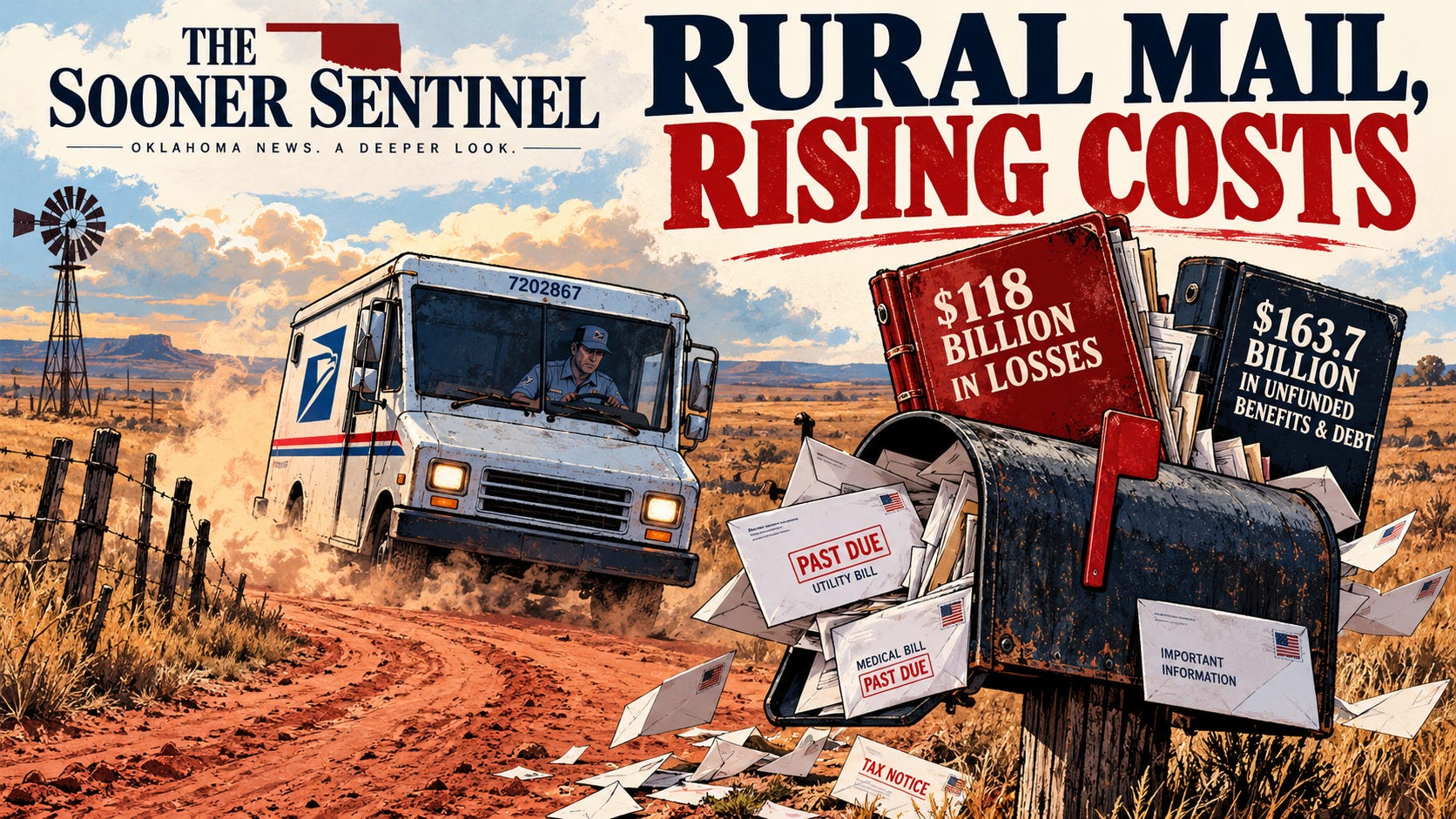
The Government Accountability Office calculates that USPS accumulated approximately $118 billion in losses from fiscal years 2007 through 2025, excluding a one-time noncash accounting benefit associated with the 2022 postal reform law. www.gao.gov
For fiscal year 2025 alone, USPS reported approximately $80.6 billion in revenue and a $9 billion net loss. The previous year’s net loss was approximately $9.5 billion. about.usps.com
Those numbers deserve an explanation. The $118 billion in cumulative losses is not the same thing as $118 billion paid by taxpayers. Postal losses include accounting expenses and obligations that do not necessarily represent cash provided by the Treasury.
USPS did report $56 billion in net income for fiscal 2022, but that apparent profit resulted almost entirely from a one-time, noncash accounting change after Congress revised retiree-health funding requirements and canceled past-due prefunding obligations. It did not mean the agency had earned $56 billion in cash or fixed its operating problems. about.usps.com
Even using USPS’s narrower adjusted measure, the fiscal 2025 picture was troubling: The agency reported a controllable loss of approximately $2.7 billion, up from approximately $1.8 billion the year before. That measure excludes certain retirement and workers’ compensation expenses and should be read alongside—not in place of—the full accounting result. about.usps.com
GAO has kept the Postal Service’s financial viability on its high-risk list since 2009, citing a business model strained by declining mail volume and rising costs. files.gao.gov
Taxpayer support, debt and unfunded obligations
Although postal losses are not automatically taxpayer losses, federal taxpayers have provided substantial support.
USPS received $10 billion for COVID-related operating expenses in fiscal 2021 after Congress removed the repayment requirement. Congress also provided $3 billion for zero-emission postal vehicles and related infrastructure. Annual appropriations of roughly $50 million to $60 million since fiscal 2019 have reimbursed USPS for specified services, including free mail for the blind and overseas election mail. about.usps.com
Those first two items total $13 billion in identified federal funding, but they are not a complete accounting of every federal cost associated with USPS. They were also provided for specific purposes, so they should not all be described as payments to cover ordinary operating losses.
The larger concern is the combination of debt and promised benefits for which sufficient funds have not been set aside.
At the end of fiscal year 2024, the Government Accountability Office reported that USPS had approximately $163.7 billion in combined unfunded benefit liabilities and debt. That total included unfunded pension and retiree-health obligations, workers’ compensation liabilities and other liabilities, along with outstanding borrowing. files.gao.gov
To put that figure in perspective, GAO said the combined obligations and debt amounted to approximately 206 percent of the Postal Service’s annual revenue in fiscal 2024. In fiscal 2007, the comparable figure was approximately 82 percent. files.gao.gov
Included in the combined total was $15 billion borrowed from the U.S. Treasury—the Postal Service’s statutory borrowing limit. It would be incorrect to add that $15 billion again to the $163.7 billion total. It would also be incorrect to claim the entire $163.7 billion has already been paid by taxpayers. These are obligations and debt, and the eventual taxpayer cost remains uncertain. files.gao.gov
Congress’s 2022 cancellation of approximately $57 billion in past-due retiree-health prefunding payments provided a major noncash accounting benefit to USPS. It was not a $57 billion cash payment by taxpayers. The law also integrated postal retiree health benefits with Medicare, shifting some costs to that program. files.gao.gov
GAO has warned that the Postal Service’s inability to fully fund its obligations increases the risk that taxpayers could eventually have to help meet them. That risk deserves public attention even though its final cost cannot yet be stated. files.gao.gov
The financial picture is serious without inflating the numbers: approximately $118 billion in cumulative losses through fiscal 2025, billions in federal support, and $163.7 billion in combined unfunded benefit liabilities and debt at the end of fiscal 2024. These figures describe different things and should not be added together as though they were separate taxpayer bills.
Less productive, more expensive
The Postal Regulatory Commission’s fiscal 2025 analysis gives an especially troubling picture of efficiency.
The commission found that total mail volume decreased by 3.7 percent, while operating expenses increased. Its measure of total factor productivity fell by 2.1 percent, the ninth decline in ten years. Meanwhile, prices for the commission’s “market-dominant” products, including First-Class Mail, increased by approximately 15.2 percent between July 2024 and the end of fiscal 2025. www.prc.gov
That does not mean every stamp price rose by exactly 15.2 percent. It does mean customers faced substantial increases across a group of products where the Postal Service holds a dominant legal position.
Americans are being asked to pay more while the agency handles less volume and its productivity measure declines. That is not the sort of performance that should be waved away with a promise to appoint a board member who understands rural America.
Slower delivery is a rural problem
The service numbers are no more reassuring.
GAO reported that First-Class Mail on-time performance fell from approximately 91 percent in fiscal 2022 to 86 percent in fiscal 2025. That is a nationwide measure, not a claim that every Oklahoma community experienced the same decline. www.gao.gov
GAO also found that USPS lengthened expected delivery times for some First-Class Mail as part of its cost-cutting strategy. Beginning in 2021, certain mail was given an additional one or two days as USPS shifted transportation from air to ground. In 2025, USPS changed collection practices at more than 24,000 post offices located over 50 miles from a regional processing and delivery center.
According to oversight bodies and industry stakeholders reviewed by GAO, these changes slowed some mail and disproportionately affected rural customers. USPS also lowered its performance targets in fiscal 2021 and has missed most targets since then. files.gao.gov
There is an obvious irony here: The people invoked to defend the existing system are among those being asked to tolerate slower service while USPS tries to repair its finances.
GAO also reported that 19 to 23 percent of First-Class Mail was excluded from service-performance measurement in fiscal years 2023 through 2025. Exclusions can occur for several reasons, including missing scans; the figure does not establish that all excluded mail was late. But oversight bodies have questioned whether the measured mail is sufficiently representative. Customers deserve to know how much confidence they can place in the reported numbers. files.gao.gov
The Civil War-era postal fight
The dispute over government control of the mail is older than the Postal Service itself.
One relevant case arose in Philadelphia around the beginning of the Civil War. Private company Blood’s Despatch delivered local letters, and federal authorities sought to shut it down after the postmaster general designated city streets as postal routes. In 1860, a judge ruled partly in the company’s favor, distinguishing “post roads” from “post routes.” Congress then changed the law to include post routes, and Blood’s Despatch went out of business within a year. postalmuseum.si.edu
In my opinion, the position that a private company should be allowed to deliver letters was spot on.
If a business can provide a service that customers voluntarily choose, the government should have a compelling reason to forbid it—especially when the prohibition helps protect the government’s own operation from competition.
The history is broader than that one case. In 1844, before the Civil War, Lysander Spooner’s American Letter Mail Company offered private service between several major cities. Congress tightened restrictions on private intercity letter delivery in 1845. The Smithsonian’s postal history explains that Congress feared private operators would take profitable routes and leave the government with the more expensive ones. postalmuseum.si.edu
That concern deserves an honest answer. It does not prove the monopoly is the best answer.
Spooner’s operation served major cities; it did not demonstrate that private companies would automatically deliver affordably to every remote Oklahoma address. But it did illustrate a principle that remains relevant: Americans should be permitted to test whether competition can offer customers a better deal.
What competition can—and cannot—promise
The Postal Service’s legal monopoly principally concerns certain letter delivery. Packages have never been included in that monopoly, and private carriers already compete in the package market. USPS’s own history and Supreme Court decisions describe the letter-mail restrictions, subject to legal exceptions. postalmuseum.si.edu
Opening more letter delivery to competition could give customers and communities additional choices and put pressure on USPS to improve. It could also produce different prices and service levels in different markets.
We should be honest about the tradeoff: Delivering to scattered homes on long rural routes costs more per customer than serving a dense neighborhood. Private carriers may choose not to serve every route at a price residents consider affordable. The current universal-service framework addresses that problem by spreading costs across the network.
So if Congress changes the monopoly, it must also explain how rural service will be maintained, what it will cost, and who will pay. Options worth examining include competitively awarded rural delivery contracts, partnerships with local businesses and carriers, or a narrowly defined, transparent subsidy where competition alone does not provide adequate service.
A subsidy is still a cost. But an explicit cost that Congress debates and the public can examine is preferable to pretending a protected system has no tradeoffs.
Questions for Oklahoma’s senators
The legislators are right to ask nominees about rural Oklahoma. Senators should also ask:
What measurable improvements will rural customers see, and by when?
How will USPS improve on-time delivery without simply lengthening its delivery standards?
Why has productivity declined in nine of the past ten years, and what will management do differently?
How will USPS address its losses, Treasury debt and unfunded obligations without shifting additional costs to taxpayers?
How will customers know whether USPS’s performance measurements accurately represent the mail being delivered?
What would happen to rural prices and delivery if Congress permitted more private letter-mail competition?
What is the actual cost of universal rural service, and how should that cost be disclosed and funded?
Those questions deserve more than reassuring language from prospective governors.
Protect the customer
Jamison’s post raises an issue that matters to Oklahoma, and the legislators’ concern for rural residents is justified. But good intentions cannot deliver a prescription, balance a budget or repair a broken business model.
The Postal Service has a difficult public mission, and its employees deliver an enormous volume of mail under constraints Congress has imposed. Those facts deserve recognition. So do the $118 billion in cumulative losses, the $163.7 billion in combined unfunded benefit liabilities and debt, the federal support and financial exposure, the declining productivity and the slower service documented by the government’s own watchdogs.
Rural Oklahomans should not be left without reliable delivery. Neither should they be told that the only way to protect it is to preserve every legal privilege of the institution that has struggled to provide it.
Congress should put the customer first: measure performance honestly, disclose the cost of rural service, permit more competition and demand a credible plan for the obligations that remain.
A mailbox at the end of a country road is worth protecting. A government monopoly should have to justify itself.