

SPECIAL EDITION
By Marven Goodman, June 5, 2025
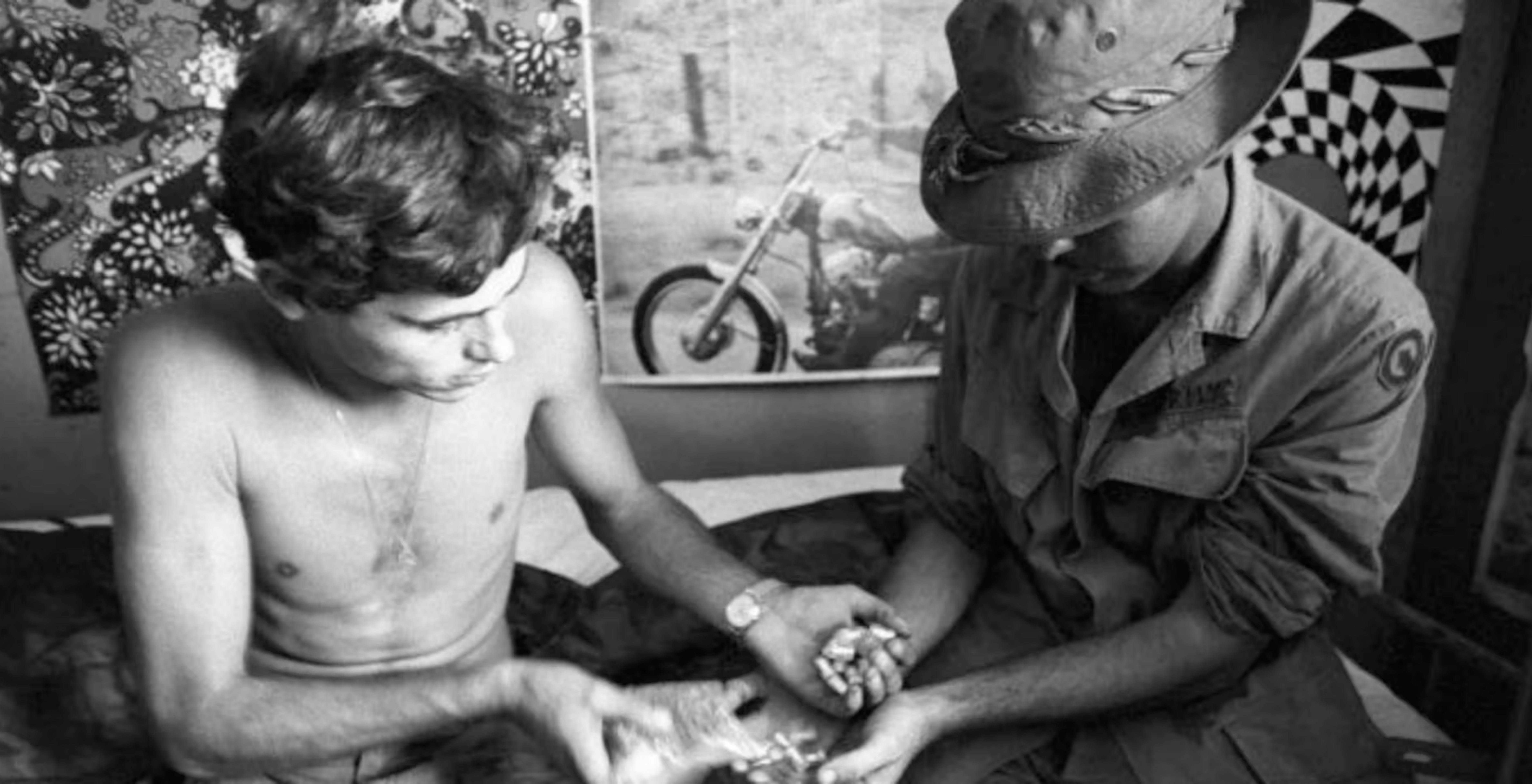
John Prine’s song “There’s a Hole in Daddy’s Arm Where All the Money Goes” poignantly captures the destructive cycle of addiction, portraying a Vietnam veteran whose heroin dependency drains his resources, leaving his family in despair. The metaphor of the “hole” vividly illustrates how addiction consumes everything, money, stability, and hope, without yielding meaningful returns.
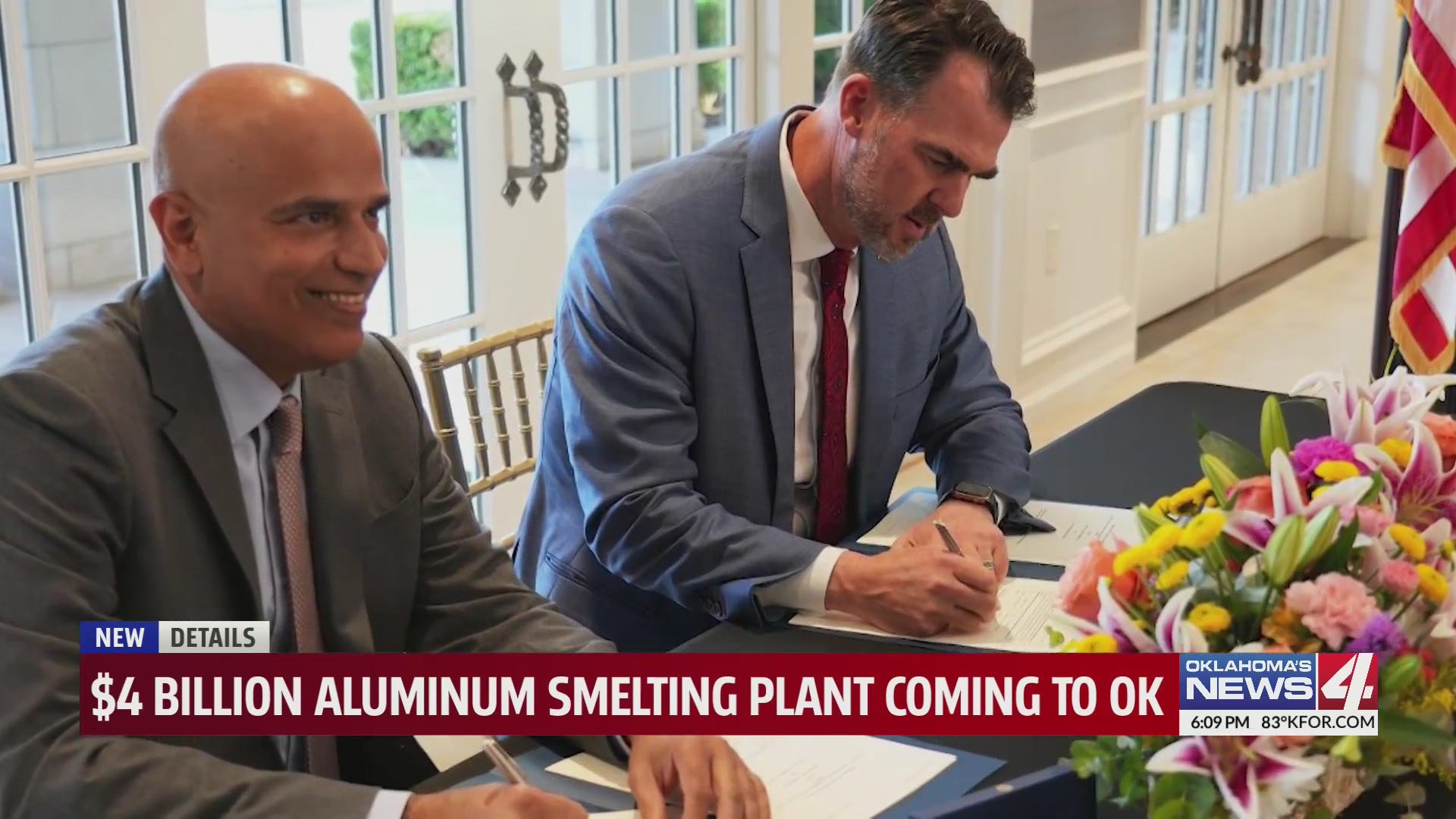
This concept of a compulsive, self-destructive drain finds a chilling echo in the Oklahoma State Legislature’s spending habits, particularly its headlong plunge this year into a $4 billion aluminum smelter deal with Emirates Global Aluminum (EGA) at the Tulsa Port of Inola. A closer look reveals a troubling reality: inflated job projections, a strained power grid, and a staggering cost per job that could reach $2.5 million per position.
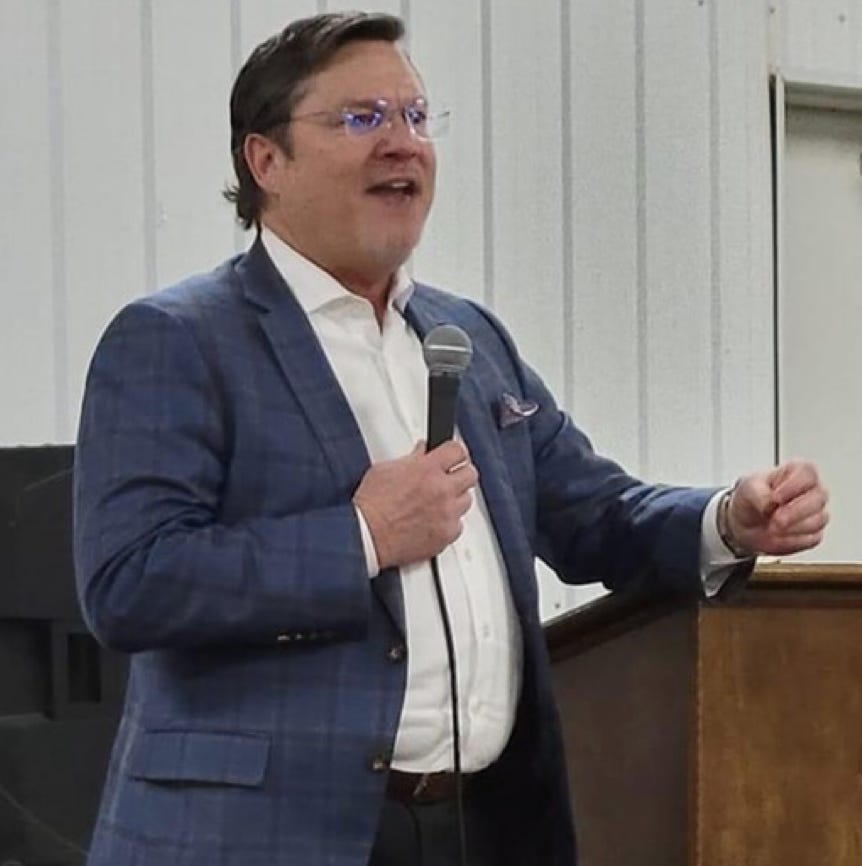
As the 2026 election season heats up, Senator Chuck Hall (R-Perry), Senate Appropriations Chairman, stands at the center of this fiscal storm, with his recent electioneering mailer from OklahomaBlueprint.com proclaiming “Promises Made, Promises Kept” and touting “Lower Taxes, More Jobs, Safer Neighborhoods, Better Schools”, claims that are speculative at best and belie a troubling record of fiscal missteps and political contradictions.
The Inola Smelter: A Billion-Dollar Hole in Oklahoma’s Budget
In May 2025, Governor Kevin Stitt unveiled the EGA aluminum smelter deal, heralding it as the first new primary aluminum plant in the U.S. in 45 years, with a projected capacity of 600,000 tons annually and 1,000 direct jobs plus 1,800 indirect jobs. Supporters, including House Speaker Kyle Hilbert and Senate Pro Tem Lonnie Paxton, frame it as a cornerstone of Oklahoma’s economic ambitions, tied to President Trump’s “America First” agenda and a $200 billion UAE investment package. But the cost to taxpayers is staggering: a $255 million annuity incentive through House Bill 2781 (the Reindustrialize Oklahoma Act of 2025) to subsidize energy costs, $735 million in tax exemptions and offsets, and a $545 million Tax Increment Financing (TIF) package, totaling over $1.5 billion. With only 5.7% of TIF revenue shared with local jurisdictions like Inola’s schools, the deal prioritizes corporate welfare over community needs.
The numbers tell a grim story. If the smelter delivers 1,000 direct jobs, the cost per job exceeds $1.5 million; including indirect jobs, it’s still $555,000 per position. Critics, like Rep. Jim Shaw (R-Chandler), warn that inflated job projections could push the cost to $2.5 million per job, branding the deal “crony capitalism.” The smelter’s massive energy demands threaten to strain Oklahoma’s power grid, potentially hiking rates for residents via Public Service Company of Oklahoma (PSO). Aluminum smelting’s energy intensity, coupled with environmental risks like wastewater pollution, raises concerns about Inola’s lax regulations luring EGA at the community’s expense. Like the veteran in Prine’s song, whose addiction offers fleeting relief at a devastating cost, the Legislature’s fixation on the smelter pours taxpayer dollars into a speculative venture with no guaranteed payoff, risking a fiscal black hole if global aluminum markets falter.
Chuck Hall’s Questionable Promises
As Oklahoma’s 2026 election season officially kicks into gear, candidates are already positioning themselves, with formal filings due in April 2026, Senator Chuck Hall is wasting no time. His latest electioneering mailer, distributed via OklahomaBlueprint.com, another tall building organization, boldly claims “Promises Made, Promises Kept,” asserting he’s delivered “Lower Taxes, More Jobs, Safer Neighborhoods, Better Schools.” These claims, however, are speculative at best, and at worst, political theater.
The FY2026 budget’s 0.25% income tax cut, costing $306 million annually, is a modest gesture compared to the $1.5 billion smelter deal, offering little relief to most Oklahomans and probable tax increase, while education remains underfunded by $220 million since 2008. Job projections for the smelter are uncertain, and the PREP Fund’s paltry 400 jobs at $755,625 each undermine Hall’s “More Jobs” boast. “Safer Neighborhoods” and “Better Schools” ring hollow when flat agency budgets neglect teacher shortages and failing to hold local school boards and superintendents accountable, and public safety investments meaning what? Hall’s mailer, echoing Trump’s “Promises Made, Promises Kept” slogan, glosses over a record of fiscal overreach and unfulfilled pledges. But he keeps spouting those favored conservative values, the only problem is he tends to value the greater good of the lobbyist that contribute to his campaign.

Hall’s tenure as Appropriations Chairman, following Roger Thompson’s resignation in November 2024, reveals further contradictions. On September 28, 2022, as a banker-turned-lawmaker and former Perry mayor, Hall championed the $250 million Progressing Rural Economic Prosperity (PREP) Fund, augmented by $52.25 million in ARPA scraps, promising “transformational” benefits for rural Oklahoma. Three years later, the $302.25 million initiative has yielded perhaps 400 jobs, a cost of $755,625 per position. The Oklahoma City Stockyards’ 2024 closure, with cattle sales dropping from a million to 340,000 annually, exposes the folly of PREP’s $20 million fairgrounds investment in a saturated market. Hall’s 2022 pledge of “generational benefits” now appears as a costly miscalculation, much like the smelter’s inflated promises.
Political Contradictions and Arm-Twisting
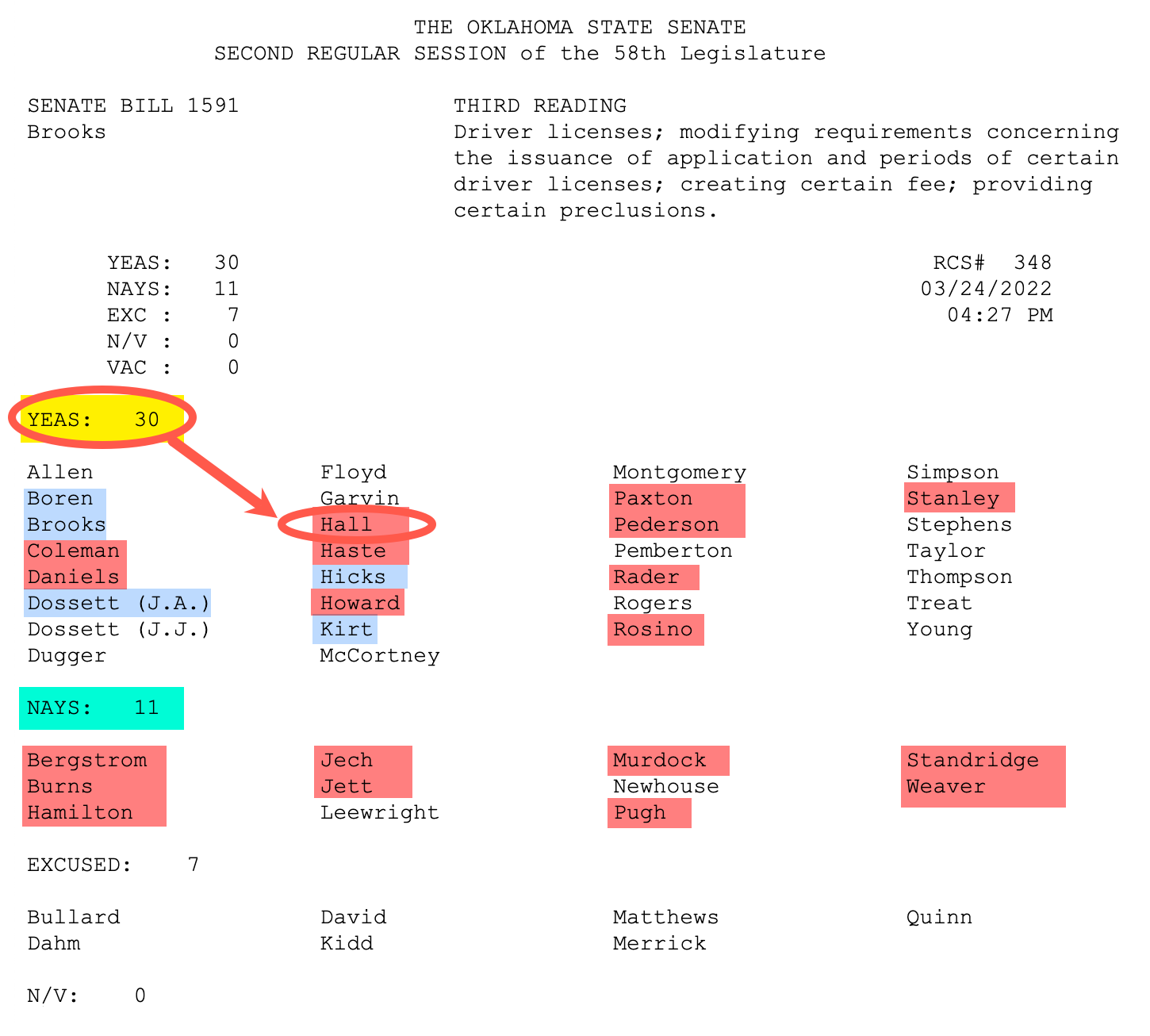
Hall’s support for driver’s licenses for undocumented immigrants further clouds his conservative credentials. In the Senate floor vote on Senate Bill 1591, one of three bills (SB 1591, SB 669, HB 2114) addressing this issue, Hall was among 10 Republicans and 30 total senators voting yea, defying 72% opposition in his district per a 2019 Harvard-Harris Poll. Cast as Vice Chair of Appropriations, this vote, before his rise to Chairman, suggests a pragmatic streak at odds with his rural base. His silence on the decision, neither defending nor retracting it, leaves voters questioning his motives, especially given his later backing of the PREP Fund and smelter deal.
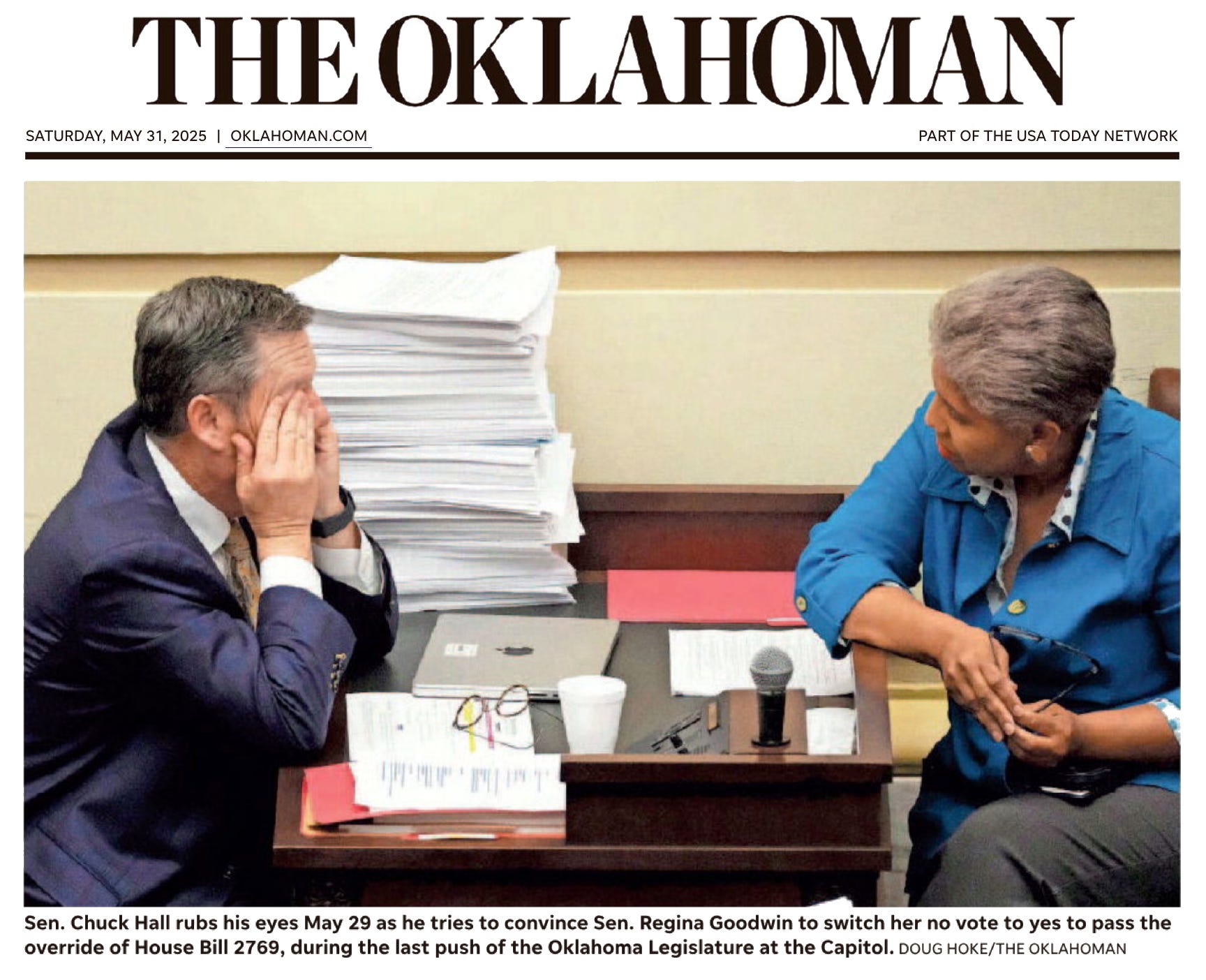
Hall’s political maneuvering was evident in the May 2025 override of House Bill 2769, a measure for financial aid to Oklahoma guard members. After a 30-16 vote fell short of the 32 needed to override Governor Stitt’s veto, Hall led a five-hour arm-twisting session, pressuring senators like Democrat Regina Goodwin, who held firm, while flipping and flopping others like Casey Murdock (R-Felt) who changed his vote 3 times. The Daily Oklahoman reported the override’s eventual 31-15 passage, highlighting Hall’s hardball tactics controlling the state purse-strings. Similar pressure secured HB 2781’s passage after a 12-12 tie, with three Republicans flipping votes post-lobbying. These episodes reveal a pattern of opaque deal-making, seriously undermining Hall’s claims of transparent leadership.
Another Crack in the Armor
In 2022, Oklahoma Senator Michael Brooks, a former immigration attorney, introduced Senate Bill 1591 to allow undocumented workers to obtain driver’s licenses using Taxpayer Identification Numbers (TINs). Aimed at improving road safety and boosting tax revenue, the bill gained support from Oklahoma State Troopers and passed the Senate Aeronautics and Transportation Committee (7-6) with rare GOP backing, including from Senator Bill Coleman. It cleared the Senate Floor on March 24, 2022 (30-11), with Senator Chuck Hall, then Vice Chair of the Senate Appropriations Committee, among the 10 Republican senators voting in favor. However, the bill died in the House due to rural Republican opposition and Governor Kevin Stitt’s lack of support.
In 2023, Brooks introduced SB 669, proposing four-year licenses for tax-paying undocumented immigrants with higher fees and voting bans to address critics’ concerns, including Stitt’s earlier remarks on voting fraud. The bill passed the same committee (7-6) but stalled before the March 23 deadline due to conservative push-back and Farm Bureau concerns. A companion bill, HB 2114 (the “LIBERTY Act”) by Representative Ryan Martinez, aimed to appeal to free-market values but also failed in the House. Hall’s vote for SB 1591, unusual for his rural district’s opposition (72% against per a 2019 poll), aligns with his later pragmatic support for the $250 million PREP Fund, though he remained silent on his reasoning.
Logan County Commissioner’s Claim of $50 Million Road Funding Deal Raises Questions
On June 2, 2025, Logan County Commissioner Mark Sharpton announced a $50 million allocation in the FY2026 Oklahoma state budget (House Bill No. 2766) to bolster county road and bridge funding, with $25 million designated for county bridges managed by the Oklahoma Department of Transportation (ODOT). Sharpton credited Senator Chuck Hall, Chair of the Senate Appropriations Committee, for orchestrating a “behind-the-scenes deal” to secure this funding, aimed at bringing counties below the $4,000 per road mile average up to that threshold. However, the lack of independent confirmation and mathematical inconsistencies in the allocation’s scope raise concerns about its feasibility and transparency.

A transcript of the Sharpton announcement:
Mark Sharpton: I’d like to bring up an action item down the road to express our appreciation to all of our representatives of 23rd and Lincoln, and Chuck Hall especially being on the budget committee. They did, I don't know if the governor has signed it or not, but they did pass a bill that's trying to bring up the lower counties into the average of $4,000 per road mile per year. We're not there, so we're one of the counties that will benefit from the $50 million that they're going to apply to the counties that are not at the average. And then 25 of that million is going to go to do some bridges through ODOT. So that still has to be worked out, how they're going to do what bridges and which ones, but anyway,
Monty Piercy: But to all of them, not just single out one.
Mark Sharpton: No. Now, Chuck, Senator Hall, was very behind the scenes because he was the Senate budget, that's how it got there. But as far as I can see, every representative in Logan voted for it. So I don't want to just point one out. I want all of them to be acknowledged for supporting more money to come to the county for roads and bridges.
Sharpton’s announcement suggests the $50 million, with $25 million for roads, would address funding disparities across Oklahoma’s 77 counties, particularly benefiting Logan County. Yet, Oklahoma has approximately 80,000 miles of county roads, according to ODOT data. If the $25 million for roads were distributed to achieve an additional $4,000 per road mile for under-served counties, the total cost would far exceed the allocated amount. For instance, even if only 10,000 miles were targeted, the cost would be $40 million, already surpassing the $25 million earmarked for roads. This discrepancy suggests either a misunderstanding of the funding’s scope or an error in Sharpton’s description of the per-mile target.
The FY2026 budget, passed by the House on May 20, 2025, and the Senate on May 22, 2025, authorizes $610 million from the Rebuilding Oklahoma Access and Driver Safety (ROADS) Fund and $204.5 million from the State Transportation Fund for ODOT. While these funds support infrastructure, including county projects under ODOT’s County Improvements for Roads and Bridges (CIRB) program, no public records, such as Senate budget breakdowns, ODOT’s Eight-Year Construction Work Plan, or news reports, explicitly confirm the $50 million allocation for counties or the $25 million for bridges. Sharpton’s claim, tied to Hall’s influence, lacks corroboration from sources like the Oklahoma Policy Institute or local media, raising questions about whether this was a formalized budget item or a preliminary agreement.
Senator Hall holds a key position in budget negotiations. His role as Appropriations Chair makes his involvement plausible, but the absence of public documentation suggests the deal may have been informal or still under development. Sharpton noted that bridge project details “still have to be worked out,” indicating the ODOT administered CIRB plan may clarify allocations later in FY2026, or may not.
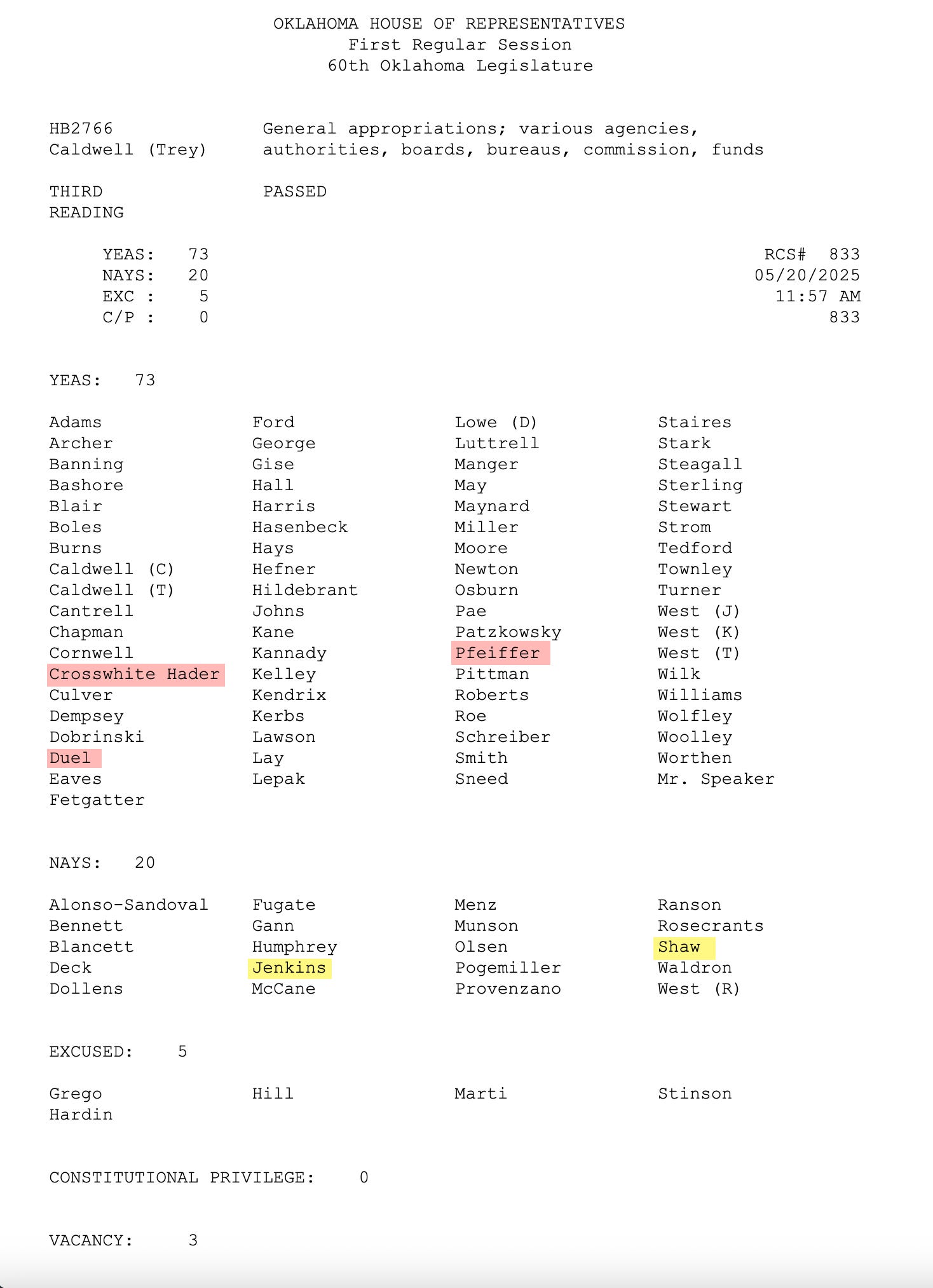
The mathematical inconsistency and lack of secondary confirmation cast doubt on the deal’s specifics. Another inconsistency is that not every Logan County representatives voted for House Bill No. 2766 with Jim Shaw and Molly Jenkins both voting no, and with Denise Crosswhite-Hader, Collin Duel, and John Pfeiffer, voting for the bill.
Until ODOT or legislative records verify the $50 million, Sharpton’s announcement remains an unconfirmed claim, underscoring the need for greater transparency in Oklahoma’s budget process.
A Pattern of Wasteful Spending
The smelter is part of a broader addiction to speculative economic development, akin to the veteran’s compulsive need in Prine’s song. The Legislature’s $312 million Lawton Correctional Facility purchase, $698 million LEAD Act, and $250 million for “Project Ocean” reflect a reckless chase for high-profile projects. These divert funds from critical needs: schools face teacher shortages, rural hospitals struggle, and mental health services rely on bailouts. The FY2026 budget’s flat funding and minimal tax cut prioritize corporate welfare over taxpayers, echoing Prine’s theme of resources vanishing into a void.
A Call for Accountability
Unlike Prine’s veteran, trapped by personal demons, the Legislature answers to 4 million Oklahomans. Hall’s leadership, marked by the PREP Fund’s failure, a divisive vote on immigrant licenses, and the smelter’s $2.5 million-per-job gamble, falls short of that duty. His OklahomaBlueprint.com mailer’s lofty claims of “Lower Taxes, More Jobs, Safer Neighborhoods, Better Schools” lack substance, banking on voter amnesia as the 2026 primary election looms. Oklahoma must break its addiction to costly economic development mega-projects and demand transparent, sustainable investments that benefit the Oklahoma taxpayers. As Prine’s song warns, pouring money into a hole only deepens the despair, it’s time for fiscal sobriety.